His Face Was On The Floor Of The Patrol Car Before He Understood What Happened
His Face Was On The Floor Of The Patrol Car Before He Understood What Happened
The door cracked at 3:15. Not a kick. A clean, surgical blow. Wood splintered. Boots filled the room before the first breath. The man on the bed opened his eyes. His hands did not reach for a weapon. His legs did not run. He just understood. The flashlight hit his pupils. The voice gave one order: down. His face met the cold tile. The floor was cold. The floor was final. Outside, the neighborhood slept. Inside, the most wanted collector of San Salvador learned that no amount of moving, no change of address every three nights, no borrowed phone, no careful walk with the head down could outrun the silence that had been tightening around him for weeks. His name was José Alberto Vázquez Martínez. They called him El Cobrador. And this madrugada, he stopped collecting.
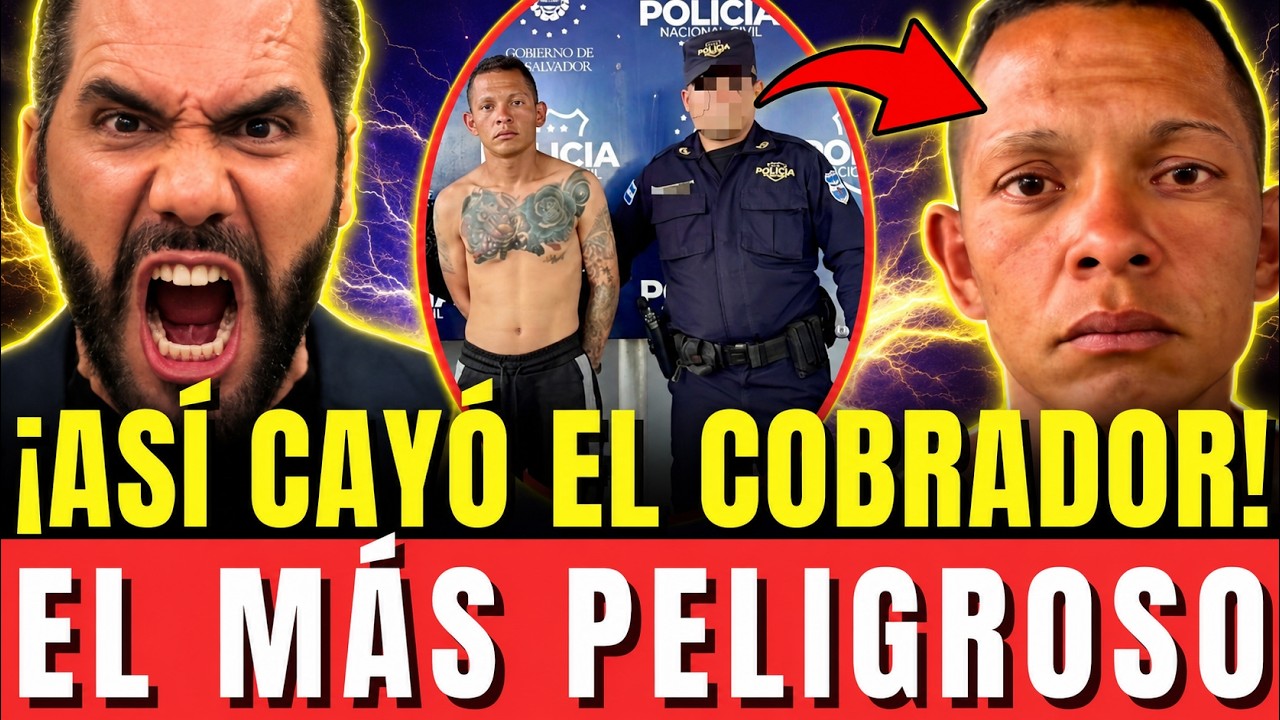
For months, José Alberto Vázquez Martínez had been the shadow that no one could grab. He belonged to the 18 Revolucionarios, the faction of Mara 18 known as 18R. His criminal record was active: extortion, aggravated robbery. But those were just words on paper. What made him dangerous was his discipline. He did not sleep twice in the same house. He changed blocks every few nights, sometimes every single night. He wore his clothes to bed—always the same dark outfit, ready to roll off the mattress and into the street if the floorboards creaked wrong.
He never used his own phone. He borrowed from neighbors, from contacts, from people who owed him favors. He did not take buses. He walked, or he hired a mototaxi, always a different driver, always a different route. He had a support network spread across at least three neighborhoods in northern Greater San Salvador—people who fed him, sheltered him, warned him. He kept two doors in every hideout: one to enter, one to flee. He breathed with the paranoia of a man who knew that the state was looking for him, but who also believed, deep down, that the state would never find him.
For weeks, that belief was almost correct. Police intelligence would get a lead: El Cobrador was seen in a certain colonia. By the time a team arrived, he had moved. A tip came about a pupusería where he had bought food. Officers interviewed witnesses. Everyone said they had seen no one matching his description. He was a ghost. And the ghost was laughing.
There is a specific kind of exhaustion that sets in when you chase a man who has turned evasion into an art form. It is not the exhaustion of physical effort. It is the exhaustion of knowing that you are always one step behind, that your information is always dated, that the man you are looking at in a photograph from last week is already somewhere else, sleeping in a different bed, under a different roof. The agents of the Policia Nacional Civil (PNC) felt that exhaustion. They had been tracking El Cobrador for months. Every lead evaporated. Every door they knocked on opened to a room that smelled of recent occupancy but was now empty. The pillow still warm. The borrowed phone still on the chair. But no man.
This is where most police forces would have given up, or at least lowered the priority. Not the PNC. Not under the new rules of engagement that President Nayib Bukele had installed years ago. The Territorial Control Plan, the state of exception, the construction of the CECOT mega-prison—all of it was machinery designed to make captures like this one possible. But machinery does not think. Machinery does not adapt. The men and women of the PNC had to think. They had to adapt. And the adaptation came from a simple but brutal change in strategy: stop chasing the ghost, and start watching the people who feed him.
Every ghost has a trail. Not the trail of his own footsteps, but the trail of the hands that give him food, the mouths that speak to him, the roofs that cover him. El Cobrador had a small, loyal network. A few contacts accumulated over years of terror. They were the ones who bought him groceries, who let him use their phone, who told him when strangers were poking around the neighborhood. These contacts had fixed addresses. They had jobs. They had families. They could not disappear every three nights.
The intelligence branch of the PNC made a quiet decision: do not touch the network. Do not interrogate them. Do not raid their homes. Do not do anything that might alert El Cobrador that his allies were being watched. Instead, observe. Watch from a distance. Note who visits them. Note what hours calls come in from borrowed phones. Note which sectors of the city the calls originate from. Note the pattern.
For weeks, teams of intelligence agents did this. They sat in unmarked cars. They stood in shadows. They logged every movement, every conversation, every small interaction. And slowly, like a map emerging from fog, the pattern revealed itself. El Cobrador was not moving randomly. He was moving between safe houses that belonged to his network. The network was small, but it was predictable. Once the PNC understood the geography of that network, they stopped chasing the man and started waiting for the moment when he would return to a specific address they had already mapped.
That moment came on the evening before the arrest.
On the afternoon of the day before his capture, José Alberto Vázquez Martínez walked out of the house where he would later be arrested. He walked slowly, as he always did, his eyes scanning the sides of the street, his posture relaxed but his pupils moving. He went to a corner store. He bought food and water. He spoke for a few minutes on a borrowed phone. Then he walked back, slowly, still scanning. He did not see the unmarked vehicles at the ends of the block. He did not see the agents on the rooftops, lying flat, careful not to make a sound on the corrugated metal. He did not feel the weight of the surveillance that had been tightening around him for days.
He entered the house. He locked the door. He ate. He lay down on the bed. He closed his eyes.
Outside, the PNC was moving into position. Not all at once. Not with lights or sirens. Teams arrived in small groups, in discreet vehicles, dressed in civilian clothes for the approach. First the perimeter: agents took positions at the four corners of the block, watching the streets. Then the rooftops: snipers and observers climbed onto neighboring roofs, careful to place their weight on the reinforced beams to avoid the telltale creak of old zinc. Then the rear: a team covered the patio, the back wall, the narrow alley that could serve as an escape route. Finally, the assault team: a handful of elite officers, their faces obscured, their weapons low, their bodies pressed against the wall next to the main door.
The silence that followed was absolute. No radios crackled. No phones buzzed. The agents had been trained to breathe quietly, to shift their weight without scraping a boot, to wait.
Inside the house, El Cobrador slept. His arms were covered, as always, to hide the tattoos that had once been his pride. But now those tattoos were a liability. “Antes lucían estos tatuajes con orgullo,” Minister Gustavo Villatoro would say later, “hoy intentan ocultarlos para evadir la justicia.” The man who had once walked with his ink showing, who had used his face as a weapon to intimidate shopkeepers and bus drivers, now hid beneath long sleeves. He slept in the dark, alone, with no idea that the hunters were already at his threshold.
The order came exactly at 3:15 in the morning. A single word over the encrypted radio. No speeches. No extended protocol. One word. In less than three seconds, the assault team moved. The main door gave way on the first push—not a kick, but a coordinated shoulder blow that shattered the lock without announcing itself to the entire block. The agents flowed into the house in a practiced formation. Each man knew his corner, his room, his sector. No one hesitated. No one shouted.
The first agent to reach the bedroom turned his flashlight onto the bed. The beam cut through the darkness and landed on the face of José Alberto Vázquez Martínez. He opened his eyes slowly. For a fraction of a second, his brain processed the light, the shadows, the men in tactical gear. Then, in less than three seconds, he understood. He did not reach for a weapon. He did not try to run. He did not fight. The only thing he did was try to sit up, as if to preserve some shred of dignity. He did not succeed. The voice ordered him face down. Hands on his neck. Do not move.
He obeyed. The man who had spent years giving orders on his block, who had collected extortion payments with a cold stare, who had made families tremble with a single glance, received his first order as a captured man and followed it without opening his mouth. The agent put a knee on his back. The handcuffs clicked. The sound was small, but it echoed in the silent room like a door closing on an entire era.
The transfer to the patrol vehicle was done without spectacle. No public walk. No media show. The agents kept him low, his head forced down, his eyes pointed at the asphalt. He was placed in the back seat between two officers. His hands were cuffed in front of him, not behind—a calculated choice that allowed him some stability but removed any pretense of control. During the entire drive to the CECOT, he did not raise his face. Not once. The man who had once used his eyes to dominate, to threaten, to make sure that his victims understood who was in charge, now kept his gaze fixed on the floor of the patrol car.
The drive was long. The roads of San Salvador were empty at that hour. The streetlights passed over the vehicle in rhythmic pulses. The agents did not speak. The man did not speak. The only sound was the hum of the engine and the occasional hiss of the tires on wet pavement. Inside the car, the air was cold from the air conditioning, but the man was sweating. His neck was damp. His fingers, cuffed together, trembled slightly. He knew where he was going. Everyone in El Salvador knew what the CECOT was. A concrete labyrinth with no windows, no yard time, no hope. A place where the state had decided that the most dangerous criminals would not rot in luxury, but would simply vanish from the surface of the earth.
When the vehicle finally crossed the main gate of the CECOT, the first thing that changed was the air. Dry, cold, artificial. Fluorescent lights hummed from the ceiling, casting a white glow that made it impossible to tell whether it was day or night outside. There were no windows in the cells. No trees. No birds. No music from neighboring houses. Only concrete, steel, white light, and a silence so thick that it pressed against the eardrums. For a man who had spent his entire life in noisy neighborhoods—with dogs barking, children screaming, buses rumbling, music blasting from corner stores—that silence was perhaps the most terrifying thing of all. Because the silence said one thing, very clearly: here, you decide nothing.
Several kilometers away from the CECOT, in the northern neighborhoods of Greater San Salvador where El Cobrador had operated for years, life was beginning to change. Not dramatically. Not with announcements. Just a small shift in the air, like the pressure before rain, but in reverse.
The woman at the pupusería who had, for months, set aside a portion of her Thursday earnings—the exact amount she had been told to keep apart, the amount that someone would come to collect on Friday morning—did not set it aside this week. She closed her cash drawer without separating the bills. She did not know why, exactly. She had not heard the news yet. But her hands remembered the habit, and her hands decided to break it.
The mechanic in the auto shop who had learned to count his cash twice before putting it in the drawer, just in case someone came to ask for the quota, breathed differently this week. He did not look over his shoulder as much. He did not lock the door during business hours. He just felt lighter, without knowing why.
The mototaxi driver who had, for years, driven with his eyes fixed on the rearview mirror, checking for anyone following him, drove relaxed that night. He did not scan the shadows. He did not take the long way home. He drove straight, humming a song.
The children who had crossed the street quickly to avoid passing near the man with the covered arms now crossed slowly, playing, kicking a can, without anyone hurrying them.
None of them knew the name José Alberto Vázquez Martínez. But they knew the fear he had planted. And now, without a single official announcement, without a press conference, the fear was lifting. Because the collector was gone. The debt was canceled. Not by payment. By captivity.
Minister Gustavo Villatoro gave a press conference hours after the capture. He confirmed the operation. He praised the intelligence work. He said the famous phrase: “Antes lucían estos tatuajes con orgullo, hoy intentan ocultarlos para evadir la justicia.” But then, at the very end, almost as an afterthought, he let slip something that few media outlets picked up. He said that during the search of the house where El Cobrador was sleeping, the agents had found not only the target but other elements. Other names. Other notes. Other data that the intelligence branch was already crossing with open files from recent weeks.
That phrase, brief and easy to overlook, was the real headline. Because it meant that the capture of El Cobrador was not an isolated victory. It was the first link in a chain. The house where he was hiding contained information about other gang members who were still at large. Other men who changed houses every few nights. Other collectors. Other shadows.
Those names, according to sources that have emerged in the hours since the operation, are already on the desk of the Ministry of Security. And the same silent, patient method—watching the network, waiting for the pattern, striking at 3:15 in the morning—is already being applied to them.
Inside the CECOT, José Alberto Vázquez Martínez sits in a cell that is identical to thousands of others. Gray concrete. A steel door. A bunk bed bolted to the wall. A toilet without a seat. A fluorescent light that never turns off. He is not the first high-value target to arrive here, and he will not be the last. The prison has been designed to break not just bodies, but identities. The tattoos that once marked him as a member of 18R are now just scars under long sleeves. The name that once made shopkeepers tremble is now just a number on a inmate list. The face that once collected money with a cold stare now looks at the floor.
Outside, the sun rises over San Salvador. The streets fill with traffic. The pupuserías open their doors. The children go to school. The mothers go to work. And somewhere in the city, other men like El Cobrador are waking up in borrowed beds, checking their borrowed phones, pulling their long sleeves over their tattoos. They have heard the news. They know that the method has changed. They know that the state is not just arresting people in mass operations anymore. The state is hunting individuals. One by one. With patience. With intelligence. With silence.
They know that somewhere, right now, an intelligence agent is watching one of their contacts. Writing down a license plate. Noting a time. Waiting for the pattern to reveal itself.
And they know that at some point—maybe tonight, maybe next week, maybe in a month—a door will crack at 3:15 in the morning. A flashlight will hit their face. A voice will give one order. And they will obey.
Because the floor is cold. And the floor is final.