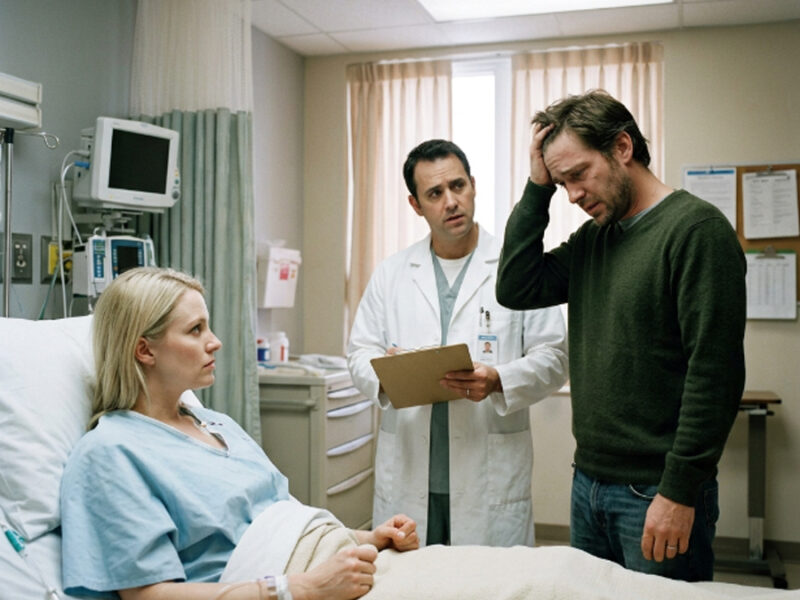
“I’m not going to accept,” she said from the hospital bed, her voice trembling but her eyes steel. I had just found out I could be her donor — the ex-husband who walked away months ago. The doctor looked at us both, confused. Then she said something that made my blood run cold: “I’d rather die than carry your guilt inside my veins.” And in that moment, I realized my divorce wasn’t the worst thing that happened to us…
“I’m not going to accept,” she said from the hospital bed, her voice trembling but her eyes steel. I had just found out I could be her donor — the ex-husband who walked away months ago. The doctor looked at us both, confused. Then she said something that made my blood run cold: “I’d rather die than carry your guilt inside my veins.” And in that moment, I realized my divorce wasn’t the worst thing that happened to us…

The fluorescent lights of Hospital General de la Ciudad de México hummed with that sickly green sound Diego remembered from his father’s final days. He was supposed to be visiting Carlos, his best friend since childhood, who’d been rushed in for emergency surgery. Pan dulce and café in hand, he rounded the corner toward the surgical wing — and stopped.
His feet wouldn’t move.
At the end of the hematology corridor, sitting alone on a plastic chair with a thin blue blanket draped over her shoulders, was Mariana.
His ex-wife.
She didn’t see him at first. Her head was down, her hands wrapped around a paper cup that looked empty. Her hair — the long, dark hair he’d run his fingers through a thousand times — was gone. Cropped short. Uneven. Like someone had cut it in a hurry, or in grief.
She wore a hospital gown. A clear IV line snaked into her arm.
Diego felt the pan dulce bag slip from his fingers.
Two months. Two months since he’d signed the divorce papers with a coldness he’d called maturity. Two months since she’d walked out of their Narvarte apartment with two suitcases and a medical folder he’d never asked about.
He thought she looked resigned that night.
Now he understood.
It wasn’t resignation.
It was exhaustion.
“Mariana.”
Her head lifted slowly. For one second, her eyes widened with surprise. Then shame flickered across her hollow cheeks. Then — something worse. A terrible calm.
“Diego.”
He walked toward her like a man approaching a crime scene he’d created.
“What are you doing here? What happened to you?”
She looked away.
“Nothing. Just some tests.”
He stared at the gown, the IV, the hospital bracelet. Her body — the body he’d held for five years — had shrunk into something fragile. Bruises bloomed purple on her arms.
“Don’t lie to me.”
She smiled, just barely. The smile he used to love. Now it was a weapon.
“You don’t have the right to ask for truth anymore.”
The words hit harder than any slap.
Diego remembered the last year of their marriage. Two pregnancy losses. The second one nearly killed her — not from blood loss, but from the way her soul seemed to hemorrhage afterward. She stopped laughing. She left food half-eaten. Some mornings he’d find her standing at the window, one hand pressed to her belly, as if waiting for a life that would never come.
He broke too. Just differently.
He broke into work. Into meetings. Into traffic jams and excuses.
And his mother, Doña Rebeca, filled the silence with poison:
“That woman is dragging you down. She couldn’t even give you children.”
Diego never defended Mariana.
He just stayed silent.
And silence, he was learning, was just another kind of cruelty.
Now, sitting beside her in that cold corridor, he understood that the night he asked for a divorce — when she looked at him with those tired eyes and asked, “You already decided this before you told me, didn’t you?” — she hadn’t surrendered.
She’d simply run out of strength to beg.
“Mariana. Tell me what’s wrong.”
She pulled the blanket tighter around her chest.
“I didn’t come looking for you.”
“But I found you.”
“That doesn’t change anything.”
“Yes. It does.”
She looked at him then, really looked. And what he saw in her eyes was worse than anger. It was disappointment.
“No, Diego. You changed your mind because you saw me like this. If I’d been strong, you’d have kept walking.”
A nurse appeared.
“Señora Mariana Torres?”
Mariana tried to stand. Her legs buckled.
Diego caught her arm. She flinched at his touch — but didn’t pull away.
The nurse glanced between them.
“Are you family?”
Mariana opened her mouth to say no.
Diego spoke first.
“I was her husband.”
The nurse’s eyes dropped to the chart.
“Then come with us. The doctor needs to discuss the results.”
Mariana went pale.
“No. Diego. You don’t have to come.”
He looked at her, feeling every moment he’d wasted crashing down around him.
“I know.”
The doctor’s door swung open.
Inside, Dr. Salcedo — glasses, soft voice, the kind of careful tone doctors use when they’re about to say something they know will break a person — reviewed the papers before speaking.
“Leukemia.”
Diego didn’t understand at first. The word floated in the room, white and cold and impossible.
Mariana closed her eyes.
Dr. Salcedo continued.
“The studies confirm the disease has been progressing for some time. We started chemotherapy three weeks ago, but the response isn’t as fast as we’d hoped.”
Diego felt the air leave his lungs.
“Time? How much time?”
The doctor looked at Mariana.
She answered first.
“Since before the divorce.”
Diego spun toward her.
“You already knew?”
She didn’t meet his eyes.
“I had suspicions. Bruising. Fevers. I got tired walking up stairs. After the second loss, the doctors wanted more studies.”
Diego remembered that folder. The one she carried the night she left. The one he saw but never asked about.
“Why didn’t you tell me?”
Mariana let out a small, joyless laugh.
“What for? You were already looking for the exit.”
“That’s not fair.”
Now she looked at him.
“Was it fair to hear your mother call me incomplete? Was it fair to watch you sit in the living room while she called me sterile? Was it fair to lose two babies, and then lose you because you were scared of my tears?”
Diego dropped his head.
There was no defense.
Months. He’d told himself Mariana was drowning in sadness to punish him. He never considered her body was also fighting a war.
Dr. Salcedo spoke carefully.
“We need to consider a bone marrow transplant if she doesn’t improve. Ideally, we’d find a compatible donor.”
“Family?” Diego asked.
Mariana’s fingers tightened.
“My father died years ago. My mother is in Puebla, heart condition. I have no siblings.”
Diego felt the blow land in his chest.
He’d been married to a woman who was practically alone — and he’d still left her more alone.
“Test me,” he said.
Mariana turned instantly.
“No.”
“Yes.”
“We’re not family.”
“That doesn’t mean it’s impossible.”
“Diego, don’t turn my sickness into your penance.”
The words froze him.
The doctor interjected.
“The probability is low, but we can run a test. We’ll also activate the national registry. We can promise nothing.”
“Do it,” Diego insisted.
Mariana looked at him with fear, not gratitude.
“Why are you doing this?”
He swallowed.
He wanted to say “because I love you.” But it sounded late. Convenient. A sentence born from guilt.
“Because you shouldn’t have been here alone.”
Mariana looked away.
That afternoon, they drew his blood.
Diego spent the next hours sitting beside her bed. She slept in fits. Woke nauseous. Sometimes she looked at him like she wanted him to leave. Sometimes like she was terrified he actually would.
At dusk, Doña Rebeca appeared.
Diego didn’t know how she’d found out. She strode in with her expensive bag, dark glasses, and a face full of disdain.
“So it’s true,” she said, staring at Mariana. “You were always a tragedy for my son.”
Diego shot to his feet.
“Mom. Shut up.”
Rebeca blinked.
“Now you defend her? When you divorced, you said you couldn’t carry a broken woman.”
Mariana closed her eyes.
Diego felt his blood burn.
“Leave. Now.”
“Diego —”
“Leave, or I’ll have security escort you.”
His mother’s jaw tightened, but she left, throwing one last venomous look.
Mariana didn’t speak for several minutes.
Then she whispered:
“That’s what I heard. When you weren’t there.”
Diego sat slowly, shattered.
“I’m sorry.”
“I don’t know if I can forgive you.”
Before he could answer, his phone buzzed.
Dr. Salcedo.
“Señor Ramírez, we have a preliminary compatibility result.”
Diego stood.
“And?”
The silence on the other end lasted two seconds. It felt like forever.
“It’s very rare,” the doctor said. “But you might be a match.”
Mariana heard from the bed.
And instead of smiling, she started to cry.
“Here’s the thing. I thought I’d finally done something right. I thought she’d be relieved. But when the doctor said those words — when she realized I could actually be the one to save her — she didn’t look grateful. She looked terrified. And then she said the words that stopped my heart.”
“I won’t accept.”
Diego stared at her, convinced he’d misheard.
Dr. Salcedo had just explained the preliminary tests showed unexpectedly high compatibility. Not definitive. More studies needed. Risks. Long, painful procedures. Uncertainty. But for the first time since Mariana started treatment, there was real hope.
And she just rejected it.
“Mariana, this could save your life.”
She sat up in bed, wrapped in the cotton jacket he’d bought at the hospital shop. Dry lips. Pale face. Eyes full of furious grief.
“I don’t want to live with your guilt inside my blood.”
Diego stood frozen.
The doctor, wisely, stepped out to give them space.
The door clicked shut.
Mariana breathed deep, like every word cost her strength.
“You’re not doing this for me. You’re doing this because you finally saw what you left behind.”
“That’s not true.”
“Isn’t it?” she demanded. “Where was this Diego when I was crying in the bathroom after the second loss? Where was this Diego when your mother told me a woman who can’t be a mother isn’t worth building a family with? Where was this Diego when I fainted in the kitchen and you said it was probably just stress?”
He closed his eyes.
Every question was a scene. Every scene, a guilt with a name.
“I was a coward,” he admitted.
Mariana went quiet.
“I don’t have another answer,” he continued. “I was scared of the pain. Scared of watching you break because I didn’t know how to hold you. So I did the easiest thing. I pretended nothing was wrong. And when I couldn’t pretend anymore — I left.”
Mariana gripped the sheet.
“I was scared too.”
Her voice changed. No longer rage. Just exhaustion.
“I was scared to tell you I was sick and watch you stay out of obligation. I was scared you’d care for me out of pity. I was scared of becoming one more burden.”
Diego stepped closer but didn’t touch her.
“You were never a burden.”
She looked up at him.
“But you made me feel like one.”
The sentence hung between them. No screaming. Just truth.
Diego sat in the chair beside the bed.
“Then I won’t ask you to forgive me today. Or to love me again. Or to erase what I did. Just please — don’t reject a chance to live just to punish me.”
Mariana looked down.
“What if it doesn’t work?”
“Then I’ll be here.”
“And what if it does work, and you get tired again?”
Diego felt that question. It was the real disease he’d left in her — distrust.
“I can’t make you believe me,” he said. “All I can do is stay long enough that one day, maybe you won’t have to ask.”
She cried in silence.
This time, Diego didn’t try to fix it with words. He didn’t say “everything will be okay.” He didn’t promise miracles. He just sat there, finally staying through a pain he’d once abandoned.
The next day, Mariana agreed to start the process.
The news spread among the few relatives she had. Doña Rebeca called seven times. Diego didn’t answer. On the eighth, she sent a voice message:
“You’re ruining your life for a woman who couldn’t even give you children.”
Diego played the audio in front of Mariana, Carlos, and Dr. Salcedo.
Then he deleted it.
“My life was ruined the day I let you speak about her that way,” he texted back. “Don’t come back to the hospital.”
Mariana looked at him with tears in her eyes.
“Before, I needed you to say that.”
“I know.”
“Now I don’t know what to do with it.”
“You don’t have to do anything.”
The studies continued. Diego was evaluated. They explained risks, side effects, recovery days. He signed every document without drama. He wasn’t a hero. He didn’t want anyone to call him that. He was just a man who’d arrived late — and was determined not to leave again.
The stem cell collection was long. He spent hours hooked to a machine, watching his blood leave through one tube and return through another. He thought about all the nights he’d wasted away from home. The messages from Mariana he’d left unread. The two babies who never came. The woman now fighting to breathe in a cold room.
When it was over, he didn’t feel pride.
He felt humbled.
The transplant happened on a cloudy morning.
Mariana was weak. She wore a mask and her eyes seemed bigger than ever. Diego entered in scrubs, gloves, carrying emotions he could barely hold.
“Are you scared?” she asked.
“Terrified.”
Mariana let out a small laugh.
“You finally said the truth without me having to pull it out of you.”
He smiled sadly.
The bag of cells seemed too small to hold so much hope. A nurse connected it carefully. No one spoke for the first minutes.
Mariana watched the tube.
“Ironic,” she whispered. “You left my life with a signature. Now you’re back through a vein.”
Diego closed his eyes.
“This time, I’m not leaving.”
She didn’t answer.
But her fingers found his on the sheet.
That night, the fever came. Then vomiting. Then days when Mariana barely woke.
Diego slept in a chair. He ate when Carlos brought tortas. He washed in the visitors’ bathroom. He learned to read the doctors’ expressions, the machine alarms, the silences that carried bad news.
One early morning, Mariana opened her eyes and found him there.
“I dreamed you left me again,” she whispered.
Diego leaned in.
“I didn’t.”
“In the dream, I called for you and you wouldn’t turn around.”
He took her hand.
“I hear you now.”
She looked at him a long time.
“I don’t know if that’s enough.”
“Neither do I.”
“But it helps,” she whispered.
On day 14, Dr. Salcedo entered with a cautious expression.
“There are signs of engraftment.”
Diego didn’t understand.
Mariana did.
Her eyes filled with tears.
“Is it working?”
“It’s still early,” the doctor said. “But her body is responding.”
Diego covered his face with both hands.
He didn’t cry loudly. He just broke silently, sitting beside her bed, while Mariana watched him with a strange mixture of tenderness and fear.
The weeks that followed weren’t a happy movie ending. There were small relapses. Bad tests. Better tests. Days when Mariana wanted to live, and others when she was too tired to try. But slowly, color returned to her face. She could sit by the window. Then walk ten steps. Then twenty.
A month later, Doña Rebeca appeared at the hospital.
She didn’t make it past reception.
Diego went down to see her.
His mother came with tears and a bouquet.
“Son, I was wrong. Let me see her.”
Diego looked at her without hate, but without weakness.
“You didn’t come when she was alone. You didn’t defend her when you destroyed her with words. You don’t get to walk in now to clean your conscience.”
Rebeca cried.
“I’m your mother.”
“And she was my wife. And I failed because I listened to you too much.”
He left her there.
When he returned to the room, Mariana was awake.
“Your mother?”
“She’s not coming up.”
Mariana nodded slowly.
“Thank you.”
It was the first time that word didn’t sound like politeness.
Three months after the transplant, Mariana was authorized to leave for a few days under supervision. Diego drove her to Coyoacán, early, when the streets were quiet. They didn’t walk much. She couldn’t. They sat on a bench by a fountain, warm coffee between their hands.
She wore a light scarf on her head. The wind moved its edges. She looked fragile — but alive.
“I don’t know what we are,” she said.
Diego looked at the ground.
“Me neither.”
“We’re not married.”
“No.”
“We’re not strangers.”
“No.”
She took a breath.
“It still hurts.”
“I know.”
“And it might hurt for a long time.”
“I’ll stay.”
Mariana looked at him.
“Don’t say that if you’re going to get tired again.”
He held her gaze.
“I can’t promise I’ll never be scared. I promise I won’t use fear as an excuse to abandon you.”
Mariana closed her eyes.
A tear rolled down her cheek.
“I don’t need a man to save me,” she said. “I need one who won’t leave me alone when I can’t be strong.”
Diego nodded.
“Then I’m going to learn to be that man.”
She didn’t take his hand right away.
It took several seconds.
But eventually, her fingers moved toward his on the bench.
It wasn’t a perfect reconciliation.
It didn’t erase the divorce.
It didn’t bring back the children they’d lost.
It didn’t turn pain into a pretty story.
But it was real.
And sometimes, after so much loss, real is enough to start again.
What would you have done in her position?