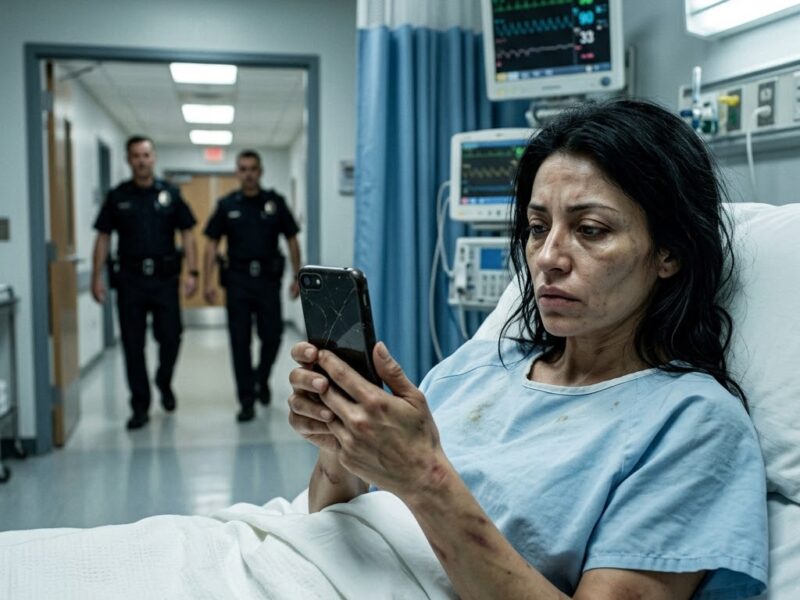
Every morning in our rundown Texas rental, my husband dragged me to the backyard, tied my hands to the porch pillar, and lashed my pregnant belly while yelling, “All you make is worthless daughters—you’re a broken wife!” The porch boards were still cool at dawn, and the sharp scrape of metal from my mother-in-law’s tool carried across the patchy yard. She never looked away. She stood close enough to hear every breath I tried to swallow, sharpening one tool after another while my husband tightened the knot around my wrists. “In America, you still fail us,” she hissed. He repeated her words like they were permission. They had decided my body was a debt I owed them. The daughters I had carried, loved, and lost sleep over were treated like evidence against me. Every cruel morning followed the same routine: the back door opening, his hand closing around my arm, the porch pillar against my shoulder, and his mother watching as if she were supervising a chore. I learned to stop begging because begging only made them louder. But I had not stopped listening. Months earlier, I found an old phone in a kitchen drawer. The screen was cracked, the battery barely held a charge, and they had forgotten it existed. At night, I wrapped it in a washcloth and pushed it deep inside my pillow. Before sunrise, I turned on the recorder and left the microphone facing the bedroom door. It caught the footsteps. It caught the threats. It caught my husband blaming me for daughters as though he had never learned basic biology, and it caught his mother telling him exactly how to frighten me into silence. That phone became the one thing in the house that did not ask me to prove what was happening. On the final morning, my knees gave out before he was finished. He cursed, loosened the rope, and dragged me through the back door while my mother-in-law complained that I was being dramatic. The old phone was still recording inside the pillow when they threw me onto the bed. I waited until they argued in the kitchen. Then I reached inside the pillowcase, slid the phone into the pocket of my loose dress, and held it there with both hands. At the county hospital, the fluorescent lights were too bright and the sheets smelled like bleach. A doctor stood beside my bed with his jaw tight and his voice unsteady. “The baby was a boy… but the damage was too much.” For several seconds, I heard nothing except the monitor and my own breath breaking apart. A boy. The son they claimed they wanted more than anything. Gone because of what they had done. My husband did not come into the room. He stayed in the hallway with his mother, telling anyone who would listen that I had fallen in the backyard. Then I heard them laugh—low, relieved laughter from two people who believed the story had ended exactly where they wanted it to. I pulled the cracked phone from beneath the blanket. My fingers shook so badly that I nearly dropped it, but I found the recording, turned the volume down, and called the police. I did not give a speech. I gave the dispatcher our address, the hospital floor, and one sentence: “I have months of audio.” The dispatcher asked me to stay on the line. Outside, my mother-in-law whispered, “She’ll say anything now.” My husband answered, “Nobody will believe her.” Then heavy footsteps struck the tile, fast and close. Their laughter stopped. A uniformed officer appeared at the end of the hallway while another moved straight toward my door, and my husband turned just as the officer reached for the handle The story is too long to post in the caption, so just say “”Yes.”” The full story will be in the comments below.
ACTO 1 — CONTINUACIÓN INMEDIATA
El oficial abrió la puerta.
Su uniforme era azul oscuro, su rostro serio, y sus ojos recorrieron la habitación en una fracción de segundo. Primero me vieron a mí, con los moretones visibles en mis brazos y el rostro demacrado. Luego vieron el teléfono en mi mano.
“Señora, ¿está bien?”, preguntó, su voz profesional pero con un borde de preocupación.
“No”, respondí. “Pero tengo pruebas.”
Mi esposo apareció detrás del oficial, su rostro pálido. “Oficial, esto es un malentendido. Mi esposa está confundida. Perdió al bebé y—”
“Señor”, lo interrumpió el oficial, “necesito que se aleje de la puerta.”
Mi suegra se abrió paso junto a él. “Ella siempre ha sido dramática. Se cae, se lastima y nos culpa a nosotros.”
El oficial la miró. “Señora, por favor, espere en el pasillo.”
“No voy a—”
“Señora”, repitió el oficial, su voz más firme, “espere en el pasillo.”
Mi suegra retrocedió, pero sus ojos me lanzaban dardos de odio.
El oficial se acercó a mi cama. “¿Qué tiene en el teléfono, señora?”
“Grabaciones”, dije, mi voz temblorosa pero clara. “Meses de grabaciones. Cada mañana, me ataban al pórtico. Me golpeaban. Mi suegra afilaba herramientas mientras miraba.”
El oficial asintió. “¿Puedo escuchar una?”
Asentí y reproduje una de las grabaciones. La voz de mi esposo llenó la habitación: “¡Solo produces hijas inútiles—eres una esposa rota!”
El oficial escuchó en silencio. Su expresión no cambió, pero vi cómo sus manos se tensaban.
“¿Tiene más?”, preguntó.
“Cientos”, respondí. “Meses enteros.”
El oficial se volvió hacia la puerta. “Oficial Martínez, ponga a esas dos personas bajo custodia.”
Mi esposo empezó a gritar. “¡No pueden hacer esto! ¡Es mi esposa! ¡Es una mentirosa!”
“Señor”, dijo el oficial, “tiene derecho a permanecer en silencio. Cualquier cosa que diga puede ser usada en su contra.”
Mi suegra intentó escapar, pero otro oficial la detuvo en el pasillo.
Mientras se los llevaban esposados, mi esposo me miró con odio. “Esto no termina aquí.”
“Termina hoy”, respondí. “Nunca volverás a lastimar a nadie.”
ACTO 2 — CONTEXTO Y ESCALADA
No siempre fui la mujer que grababa en secreto desde una almohada.
Hubo un tiempo en que amaba a mi esposo. Lo amaba con la ingenuidad de quien cree que el amor puede cambiar a las personas.
Conocí a Daniel en un rodeo en Texas. Era alto, fuerte y tenía una sonrisa que hacía olvidar todos los problemas. Me cortejó con flores silvestres y promesas de un futuro mejor.
“Voy a cuidarte”, me dijo. “Siempre.”
Y yo, joven y enamorada, le creí.
Al principio, todo fue bien. Nos mudamos a una pequeña casa alquilada, empezamos a planear una familia. Pero cuando nació nuestra primera hija, algo cambió.
Daniel quería un hijo. Un varón. Alguien que llevara su nombre y continuara su legado.
“La próxima vez será un niño”, decía. “Tiene que serlo.”
Cuando nació nuestra segunda hija, su decepción fue palpable.
“¿Otra vez?”, preguntó. “¿No puedes hacer nada bien?”
Su madre, Elena, empeoró las cosas. “En nuestra cultura”, decía, “los hijos varones son los que valen. Las hijas solo son una carga.”
Y entonces empezó la violencia.
Primero fueron gritos. Luego empujones. Luego golpes.
Cuando quedé embarazada por tercera vez, Daniel estaba seguro de que sería un niño. “Tiene que serlo”, repetía. “Esta vez tiene que serlo.”
Pero cuando supo que era otra niña, perdió el control.
“Nunca vas a darme un hijo”, gritó. “Eres una esposa rota. Inútil.”
Y así empezaron las mañanas en el pórtico.
ACTO 3 — ASCENSO AL CLÍMAX
El juicio fue rápido.
Las grabaciones eran incontrovertibles. Cientos de horas de audio. Gritos. Golpes. Lágrimas. Amenazas. Mi suegra afilando herramientas mientras yo suplicaba.
“¿Puede explicar, señor”, preguntó el fiscal, “por qué golpeaba a su esposa embarazada?”
“Ella me provocaba—”
“¿Y por qué su madre afilaba herramientas mientras usted la golpeaba?”
“Ella solo… estaba ayudando.”
“¿Ayudando a qué? ¿A torturar a su esposa?”
Daniel no respondió.
Elena testificó que yo era “dramática” y “mentirosa.” Pero las grabaciones no mentían.
Fueron declarados culpables de agresión agravada, abuso doméstico y homicidio involuntario.
Daniel fue condenado a quince años de prisión. Elena a ocho.
Cuando los llevaron esposados, Daniel me miró con odio. “¿Cómo pudiste?”
“Tú me enseñaste”, respondí. “A sobrevivir.”
ACTO 4 — RESOLUCIÓN Y TRANSFORMACIÓN
Después del juicio, me tomé un año para sanar.
No fue fácil. La pérdida de mi hijo, el trauma del abuso, la soledad. Todo pesaba como una montaña.
Pero mis hijas me mantuvieron en pie. Pequeñas, fuertes, valientes. Ellas me recordaban por qué había luchado.
“¿Mamá, vas a estar bien?”, preguntó mi hija mayor.
“Voy a estar bien”, respondí. “Porque las tengo a ustedes.”
Empecé a trabajar. Encontré un empleo en una tienda local. Ahorré para comprar una casa pequeña, lejos de los recuerdos.
Mis hijas crecieron sabiendo que eran amadas, que no eran una carga, que su valor no dependía de su género.
“Eres suficiente”, les decía cada noche. “Siempre lo has sido.”
ACTO 5 — REFLEXIÓN Y SECUELAS
Han pasado cinco años.
Vivo en una casa pequeña pero acogedora. Mis hijas van a la escuela, tienen amigos, son felices.
Daniel sigue en prisión. Elena también.
A veces, en las noches, sueño con el pórtico. Con las ataduras. Con los golpes.
Pero me despierto, respiro hondo y recuerdo que ya no estoy allí.
“He sobrevivido”, me digo. “Y soy más fuerte que nunca.”
Empecé un grupo de apoyo para mujeres víctimas de violencia doméstica. Comparto mi historia, escucho las suyas, ayudo a otras a encontrar su voz.
“¿Cómo lo hiciste?”, me preguntan.
“Encontré una manera de documentar la verdad”, respondo. “Y me aferré a ella.”
Porque la verdad, al final, siempre prevalece.